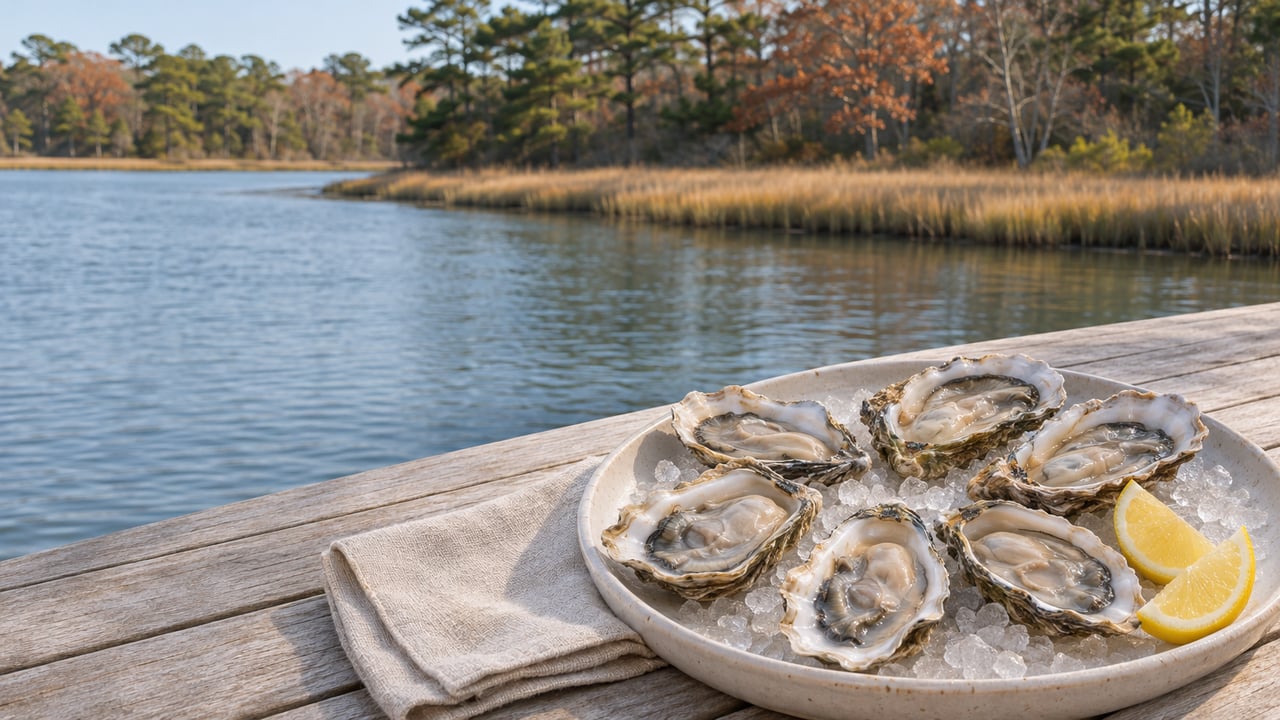
More than half of the Lynnhaven River is now open for shellfish harvest. The reopening that made headlines this year opened water to commercial growers. Almost all of the oysters coming out of the Lynnhaven are raised in cages. For people who live along the Pleasure House Road and Shore Drive corridor, the river's oyster season is a cycle. A local farm grows the oysters, local restaurants serve them, the shells go back to a nonprofit, and the nonprofit builds reef with them.
What the 52 Percent Actually Measures
In March 2026, WHRO reported that the Virginia Department of Health had opened about 250 more acres of the Lynnhaven for commercial harvesters. That brought the share of the river approved for shellfish harvest to 52%. The figure is worth comparing with where the river started. When Lynnhaven River NOW launched in 2002, only 1% of the river was open for shellfish harvest. The share then sat at about 47% for several years before this year's jump.
The same WHRO report explains who uses that water. Most shellfish harvesting in the Lynnhaven is for oysters, and about 98% of those oysters are raised in cages rather than gathered wild. Lynnhaven River NOW executive director Karen Forget told WHRO that the water quality standard for shellfish harvest is higher than the standard for swimming "because people often eat shellfish raw." So the 52% marks water clean enough to grow oysters for the table. It is not a map of public oyster beds.
The wild reefs in the river serve a separate purpose. The Virginian-Pilot's June 2026 editorial on the reopening described the sanctuary reefs as protected habitat, not harvest grounds. Their job is to filter the river and rebuild the population. WHRO also reported that ribbed mussels, a different species from the mussels on restaurant menus, appear to be "exploding" in the area. Unlike oysters, they consume bacteria such as E. coli.
Where the Lynnhaven Reaches the Table
Pleasure House Oysters is the name most often attached to a Lynnhaven oyster on a Virginia Beach menu. The farm's website lists Terrapin, Commune and Zoe's Steak & Seafood among the restaurants that carry its oysters. Visit Virginia Beach named the same three accounts in 2025. Menus change with the harvest, so it makes sense to ask your server where the oysters on the menu that night were grown.
The farm also takes guests out on the river. Its tours page lists three boat trips, all booked by phone with Captain Chris Ludford at 757-663-6970:
- Tasting Tour: $55 per person, tax included, with a four-person minimum and room for up to 14 guests
- Waterman Tour: $88 per person, tax included, with a four-person minimum and room for up to 14 guests
- Chef's Table: a boat ride out to the farm for a meal served at a table in the river, three to four hours in all, at $154 per person, tax included, with a two-person minimum
Those are the rates printed on the page. Ask about current pricing and winter dates when you call, because the farm schedules tours directly instead of posting a calendar.
The tours make a good outing for out-of-town guests over the holidays, and they show the 98% figure up close. The Lynnhaven oyster most people eat today came from a cage, at a farm working in the water the state reopened.
Where the Shell Goes Next
Shell is where the cycle comes back to the river. Lynnhaven River NOW runs the Save Oyster Shell program, known as S.O.S., which started in 2008 as a partnership with the City of Virginia Beach. It collects used shell for future reef projects. The program's own figures show how quickly it grew. It collected 2,700 bushels in 2018 and almost 9,000 in 2020, its record year and enough to build an acre of reef.
A household shucking a few dozen at home, or a family hosting a roast, has four drop sites to choose from. Clean or unclean shell is accepted at all four:
- Brock Environmental Center, 3663 Marlin Bay Dr., at the front of the parking lot where Chesterfield Street meets East Stratford Street
- Welton's Seafood Market, 940 Laskin Rd., in the parking lot
- Virginia Aquarium, 717 Virginia Beach Blvd., in the east parking lot
- LRNow's Holland Road office, 3712 Holland Rd., in the back parking lot
For a bigger gathering, LRNow will drop off collection baskets before the event and pick up the shell afterward. To schedule, email [email protected] or call 757-962-5398.
Several restaurants close to Thoroughgood also recycle the shell from customers' meals through the program. They include 1608 Crafthouse at 1608 Pleasure House Rd., CP Shuckers Bayside at 3232 Shore Dr., and Virginia Beach Dockside Seafood & Fishing Center at 3311 Shore Dr. When you order a dozen at one of those spots, the shells go back toward a reef in the river.
When a Private Dock Becomes a Research Station
The last step in the cycle belongs to people with a dock. LRNow's Spat Catcher program recruits volunteers who have access to tidal water in Virginia Beach. In the spring or fall, volunteers receive habitat cubes smaller than 12 inches square and hang them in the water from their dock for a full growing season. Each cage holds a control material, oyster shell, alongside a test material such as brick, whelk or clam shell. LRNow counts the baby oysters, called spat, that settle on each one. The results guide where the nonprofit builds reef and what it builds with. The spat then go onto an LRNow reef. The program page includes a 2026 settlement map with layers you can turn on and off, so volunteers can see how their water compares with the rest of the city.
You don't need a dock to help. LRNow also needs volunteers to build, clean and repair cages, and to count spat on collection days in the spring and fall.
The volunteers' work adds up. According to the nonprofit's 2024–2025 annual report, LRNow built 27 acres of conservation oyster reef over those two years. That brought its total to 153 acres, one acre past its 152-acre goal. Over the same period, it added 6,692 oysters and mussels to sanctuary reefs, and 58 spat-catcher volunteers took part.
Forget told WHRO that the biggest influence on the river is on land: "the runoff from roads and parking lots and driveways and shopping centers." In that same article, WHRO retold an older account from 1909. President William Howard Taft is said to have eaten well over 100 Lynnhaven oysters on a visit to Hampton Roads and called them the best he had ever tasted. The oysters now on local plates come from a cleaner river and a farm, and their shells go back to rebuild the reefs.
If you own a dock on the Lynnhaven and want to know how your shoreline, pier or tidal access affects your home's value, Jack Blake works with waterfront owners across Virginia Beach and Norfolk on exactly those questions. Let's connect, or start with a free home valuation.